Cheap or expensive boilies: which do you choose when?

Stories from the waterfront

Cheap or expensive boilies: which do you choose when?

L By Lex September 8, 20269 minute read

Sooner or later, you face the same choice: cheap bulk bait, or bait with more substance? You catch carp with cheap bait, and anyone who claims otherwise has a vested interest. What you sacrifice isn't whether a fish will come, but how long your bait continues to do what it's supposed to do: release scent, stay intact on the hair, and dissolve the moment you want it to.

For an afternoon by the water, you hardly notice that difference. For a three-day session or a three-week baiting campaign, you notice it immediately. The answer therefore depends on your water, the duration of your session, and how you structure your baiting campaign.

What is actually in a cheap boilie?

What goes into it follows from what it is allowed to cost. A boilie is flour, egg, and an attractant. The flour base determines the price and the attractant determines the catching power, and that is exactly where there is room to become cheaper.

Fishmeal, insect meal, bird food, and milk protein are the expensive ingredients. Semolina, soy meal, and cornmeal are not. A mix built on price therefore shifts towards the cheaper end of that list and fills the flavor gap with a bottle of flavoring. That is not a trick; that is calculation. The result is a ball that looks the same, smells the same as long as you hold it in your hand, but has much less to say at the bottom.

On top of that, bait from a shelf needs to be shelf-stable. A shelf-life boilie sits on a pallet, in a truck, and in a shop for months, and that is only possible with preservatives and a lower moisture content. That is not a criticism, because without that step, you cannot sell such a product. However, it is the reason why the ball is harder and dissolves more slowly than bait rolled last week.

If you want to know what you have in your hands, read the bag. If there is an ingredient list with the types of flour in order, then you know something. If there is only a flavor name and a picture of a carp, then you also know enough.

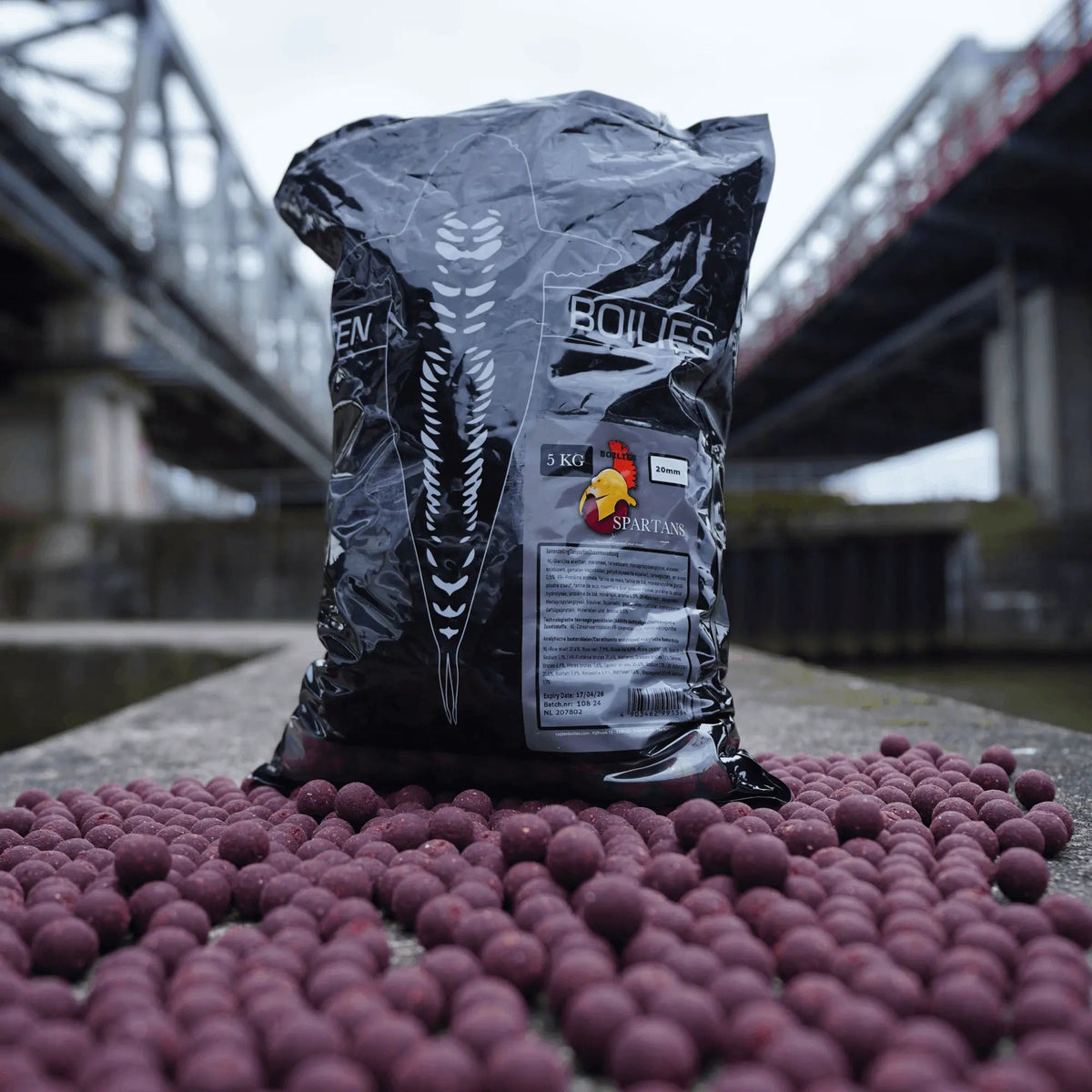
Spartans boilies
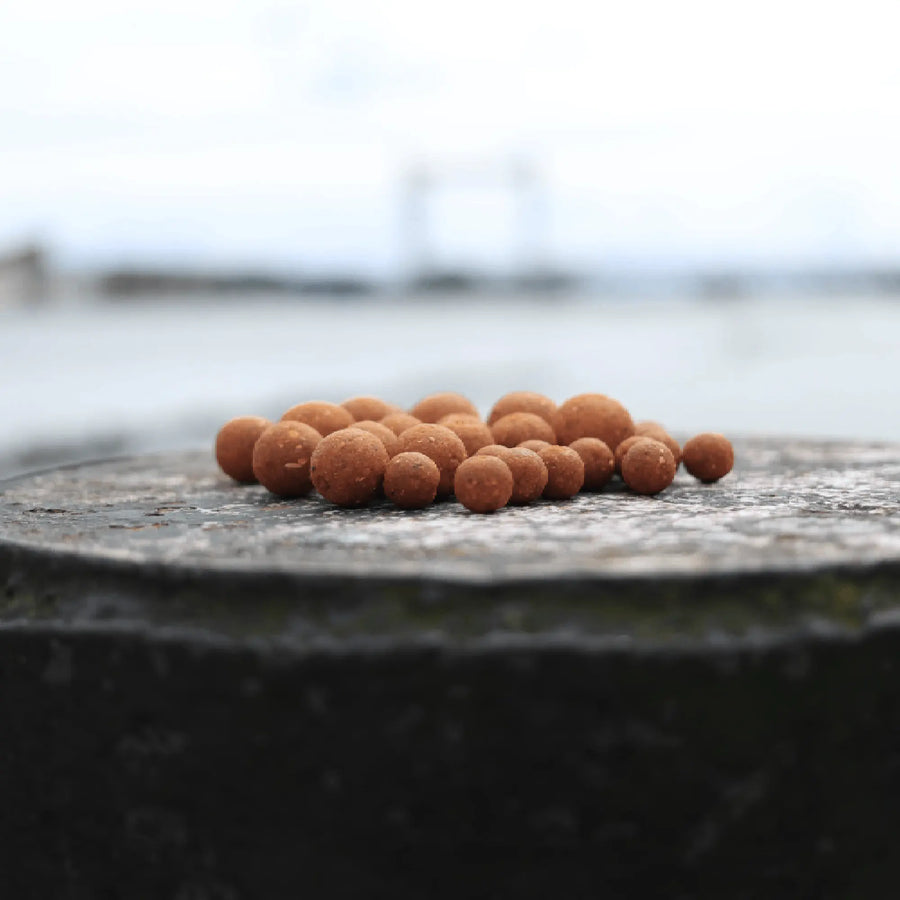
Drukz boilies close-up
By the waterside

Left: the photo this article needs most, two boilies side by side after a few hours in the water. Right: what is already there.

What do you sacrifice when you fish with cheap bait?

Four things, in this order of importance: how long the attraction stays suspended, how the ball holds up on the hair, when it dissolves, and how well it holds its own among the small fish.

Attraction.A boilie works because something leaches out of it. Amino acids, oils, salts, and soluble proteins draw the edge of your fishing spot towards you. If that attraction is in the flour base itself, it continues to release as long as the ball is there. If it is mainly in an aroma that has rolled along on the outside, most of it will be gone before your coffee is cold. You are then fishing with a ball of flour that was interesting for the first half hour.

Hardness.A hard ball stays intact longer and keeps small fish away from your hookbait, and that sounds like a win. You only see the downside when you fish at a spot where the carp are feeding cautiously: a rock-hard boilie releases nothing and sits differently on the hair. Our Spartans are deliberately a bit harder and tougher, and that is a choice for a specific situation, not a characteristic that is always better. You cansee exactly what that is intended for in the Spartans range .

Spartans levermeelboilies van Cuyten Boilies voor karpervissen

From this article

Spartans Boilies

€42,50 / 100 g

View the hookbait

The same mix as the boilie, only harder and tougher. For the quality layer on the hair.

Dissolution time.This is the aspect you want to have the most control over, and where cheap bait falls most short. Freshly rolled bait falls apart after a few hours, leaving behind a cloud that attracts the fish. Heavily preserved bait remains on the ground. On a spot where you have been pre-baiting for three days, you want your bait to disappear and be replaced, not a layer of old bait lying on the bottom waiting.

Small fish.A softer, fast-dissolving bulk ball is easy work for bream, chub, and dwarf catfish as well. On waters teeming with these fish, your bed will be cleared faster than you think, and your hookbait will lie in a bare spot without a carp having to get involved.

Toughness is a choice for a situation, not a trait that always wins.

What you do not surrender, and that is frankly the point of this entire article, is the catch itself. A hungry carp that comes across a ball of meal will eat that ball of meal. Carp don't read labels.

A carp doesn't read labels. It does, however, read whether it will encounter anything when it returns.

When is cheap bait good, and when is it not?

Fine

Short sessions, needing a lot of bait, shallow and warm water, and the period when you are learning a new spot.

Not fine

Long sessions, cold water, and any situation where the fish is picky.

If you go fishing for an afternoon or a night on a water where carp are accustomed to bait, the difference between a cheap and an expensive ball is small enough not to lose sleep over it. The same applies if you mainly need volume. Anyone wanting to lay a bed on a large lake needs kilos, and there is no shame in buying those kilos cheaply and choosing your hookbait separately.

In cold water, a carp eats less and more slowly, and then the question of how long you keep releasing bait suddenly becomes the most important one there is. A ball that does nothing after an hour is lying there for nothing. The same applies to waters with high fishing pressure, where the fish know the bait and notice the difference between a real attraction and a mere aroma. And it applies to any baiting campaign that runs for longer than a week, because you are building something up and you want the fish to encounter the same thing every time.

The shortest version: cheap bait is fine if you are fishing for fish that are already willing to eat. As soon as you have to persuade the fish, you want a ball that has something to say.

How do you build volume without feeding a hundred kilos of expensive bait?

By separating the bulk layer from the quality layer. You add volume with what is affordable, and you ensure that what lies in between and what hangs from your hair is the most interesting thing there.

On small bodies of water, this is hardly an issue. It only becomes a real problem on large bodies of water, where you can't achieve anything with just a handful. Mark de Zwart, who fished the French lakes near Bordeaux, explains why:

"If you were to build up that spot purely and solely with luxury quality boilies, you would easily be talking about tens to even a hundred kilos of bait for a week-long session. Financially, that is completely unattractive for most anglers."

"Mark de Zwart, on the lakes near Bordeaux"

Those French lakes are known for enormous stocks of whitefish, crayfish, and migrating schools of carp. To build a spot on open water there and really hold the fish, volume is simply necessary. Does that mean you have to compromise on such waters? No. It means you structure the layer beneath your bait differently.

The foundation, for volume and activity.Corn is dirt cheap, visually appealing, and immediately gets whitefish and small carp active at the spot. Tiger nuts are hard, hold off whitefish and crayfish, and are still there long after the corn is gone. We do not sell particles ourselves, so this is not a sales pitch: it is simply the cheapest way to get volume at a spot. If you supplement that base with boilies, look at the larger sizes. Per kilo, 25 and 30 mm are the most economical, and on a bed full of small fish, that size already works to your advantage.

The quality layer, to hold and hook fish.Deliberately feed a smaller amount of real bait over that. That remains there once the corn has been cleared away, and it is what the fish are left with at that spot. Your hookbait comes from that same layer, possibly as a pop-up or hard hookbait, so that the larger and more cautious fish coming to clear the spot encounter your ball exactly.

Drukz hard hookbaits van Cuyten Boilies voor karpervissen

From this article

Drukz Hard Hookbaits

€9,99 / 100 g

View the hookbait

The same mix as the boilie, only harder and tougher. For the quality layer on the hair.

Base, bed and hookbait: three layers, three price classes.

Two things to keep in mind when working like this. Keep the flavour profile consistent: a sweet bed with a fishy hookbait on it works against you, because the hookbait stands out in the wrong way. And keep an eye on the diameter. If there is a 20 mm bed and you put 12 mm on it, that is a choice and not an accident, but do know what you are doing. Our ranges run from 12 mm to 30 mm and not every range has every size, so check what is available in the size you are fishing.

Lex has the floor

[Personal passage from Lex. Specifically: which water, which month, what was in the bucket and how much of it was fed, only as food or also on the hair, and what happened. If it just worked: say so. If there was a switch, then why is the interesting part.]

A carp doesn't read labels. It does, however, read whether it will encounter anything when it returns.

What does a brand that rolls fresh do differently?

It rolls today what you fish next week, so it doesn't have to do anything to keep the ball good for months. That is the whole difference, and everything you notice at the waterside stems from that.

No preservatives means a higher moisture content, and therefore that the attractant remains mobile instead of fixed in place. It also means that your bait belongs in the freezer and not in the shed, and that is a real disadvantage: you have to remember to keep it. We roll all ranges fresh, from Drukz with krill, fenugreek, and maple to the rest of the boilie assortment , and the flour base comes from first-hand sources. That last point is the only real argument for the price. Not that it smells better, but that you know what goes into it and that there is nothing in it that is only there to keep costs down.

What we can't do, however: a bag you pick up in a shop on the way because you forgot it. Bait from a shelf is good at that, and the two aren't mutually exclusive. Many anglers have a bucket of cheap groundbait next to a bag of freshly rolled hookbait, and that is a fine way to do it.

Social proof

Based on true stories

No marketing talk, but real catches from real fishermen. This is why we do what we do.

Luca's Scopex boilies van Cuyten Boilies voor karpervissen LUCA'S

26.2 KG

A dream fish in the French jungle!

— tobias_dutchcarpangler

Insecticons insectenmeelboilies van Cuyten Boilies voor karpervissen INSECTICONS

22.5 KG

25mm wafter is my favorite for targets

— stefanvangameren_carp0180

Spartans levermeelboilies van Cuyten Boilies voor karpervissen SPARTANS

17.8 KG

Beautiful fish, great session!

— robin_dutchcarpangler

Drukz krillboilies van Cuyten Boilies voor karpervissen DRUKZ

00.0 KG

Quote from the fisherman

— Instagram name

Frequently Asked Questions

Yes, they can, especially on waters where carp are already used to bait and are actively feeding.

Shelf life bait is preserved and dried so that it can be kept for months outside the freezer. Freshly rolled bait is not; it remains moister, releases for longer, and dissolves faster. The former is more convenient, but the latter performs better on the bottom.

That is possible, but it yields little benefit. What isn't in there won't get in through the freezer. Freezing is useful for fresh bait, because that is the way to keep it good.

For the bed, choose a size that suits the water and the quantity of small fish, usually 20 mm, and select your hookbait accordingly. In cold water or at a difficult spot, 12 mm or 15 mm is often the better choice. We do not roll anything smaller than 12 mm.

No. On a short session with biting fish, you pay for something you don't notice. The difference counts the moment you have to persuade the fish instead of serving it.

Lex

PERSONAL ADVICE FROM THE OWNER

ARE YOU STILL DOUBTING?

Feel free to call or text Lex. Tell him which water you fish on, which season, and how long your sessions last, and he will personally help you think through the best choice.